You finished your draft. Maybe it took six months. Maybe it took three years. And now you’re looking at this sprawling, imperfect, occasionally brilliant mess of pages, and you’re not sure what to do with it.
Here’s what I’d tell you to do: outline it.
Not before you write the next draft. Not to plan what comes next. Outline what you already have — all the way through, from the first scene to the last. Because the outline you can make now, after finishing the draft, is exponentially more useful than any outline you could have made at the beginning.
Why? Because now you actually know the story.
You Can’t Outline What You Don’t Know Yet
A writer I’m coaching recently finished the full draft of her YA mystery novel. Then she did exactly this — created a detailed outline after the fact. It felt wrong to her at first.
“It’s so backwards to everything I do in my work world,” she told me. “We start with an outline and go from there.”
In her day job, she writes corporate content. The process makes sense there: map out what needs to be covered, structure it logically, write the words. It works because she already knows the information. The outline organizes existing knowledge.
But fiction doesn’t work that way. At the beginning of your story, you don’t know who your characters really are yet. You don’t know how they’ll respond to pressure, which details will matter, what connections will emerge between events, or what the story is actually about. You haven’t spent time with them.
I told her: if you spent a week with this story, your outline is going to be limited. But once you’ve spent ten weeks with it — or ten months — your understanding of it is so much deeper. That understanding is what makes the outline useful.
What You Know After You Finish
After completing her draft, this writer knew things she couldn’t have known at the beginning. She knew how her two protagonists differed in their approaches. She knew which secondary characters actually mattered. She knew where the real emotional beats landed and what the story was actually about — which wasn’t quite what she’d thought when she started.
When she created her post-draft outline, something happened that she couldn’t have planned. She noticed that in the historical timeline, her protagonist meets a mentor who explains how a crucial element of the magic system works — and suggests that knowledge should be recorded for future generations. And in the contemporary timeline, the modern protagonist discovers an old document with a dedication that links directly back to that historical character.
“I was like, oh, I’m a genius,” she said. “This is awesome.”
Could she have planned that connection at the beginning? Probably not. She had to write both timelines, spend time with both characters, and let the world develop naturally.
She had to embrace the discovery process in her writing.
Only then could she see how those pieces connected. That’s not something you outline in advance. That’s something you discover — and then, when you outline after the fact, you can see it clearly for the first time.
What the Post-Draft Outline Actually Does
The outline you make after finishing your draft isn’t scaffolding for a building you haven’t built yet. It’s a blueprint of the building you’ve already constructed — showing you where the load-bearing walls are, where you can open things up, and where you might add a secret passage between the library and the study.
With that blueprint in hand, my client could suddenly see everything at once. Which chapters needed to move. Where information should be revealed. Where her two timelines should intersect for maximum impact. Which scenes were doing real work and which were just passing time.
“Now I know what the content is,” she said, “and now I know how to piece it together.”
That shift — from discovery to organization — is what makes revision feel like a different process entirely. You’re not trying to fix a story while simultaneously figuring out what it is. You’ve separated those two things. The draft was for discovery. The outline is for seeing what you found. Revision is for making it better.
The Three Phases, In Order
The reason so many writers find revision overwhelming is that they’re trying to do all three of these things at once:
First draft: Discovery. Figure out what happens. Meet your characters. Learn your world. Find your story.
Post-draft outline: Organization. See the shape of what you’ve discovered. Identify connections. Map the structure.
Revision: Enhancement. Add the layers, connections, and depth that your new understanding makes possible.
The outline belongs in the middle — not at the beginning — because that’s when you finally have something worth outlining.
What This Means For Where You Are Right Now
If you’re staring at a blank page and trying to outline your novel before you’ve written it, give yourself permission to write a messy first draft instead. The outline you make now will be based on a week’s worth of knowledge. Write more. Build your understanding first.
If you’ve finished a draft and it feels like a tangled mess, try creating an outline now. Not to follow rigidly, but to see what you’ve actually built. You might be surprised by the connections that become visible once you can see the whole thing at once.
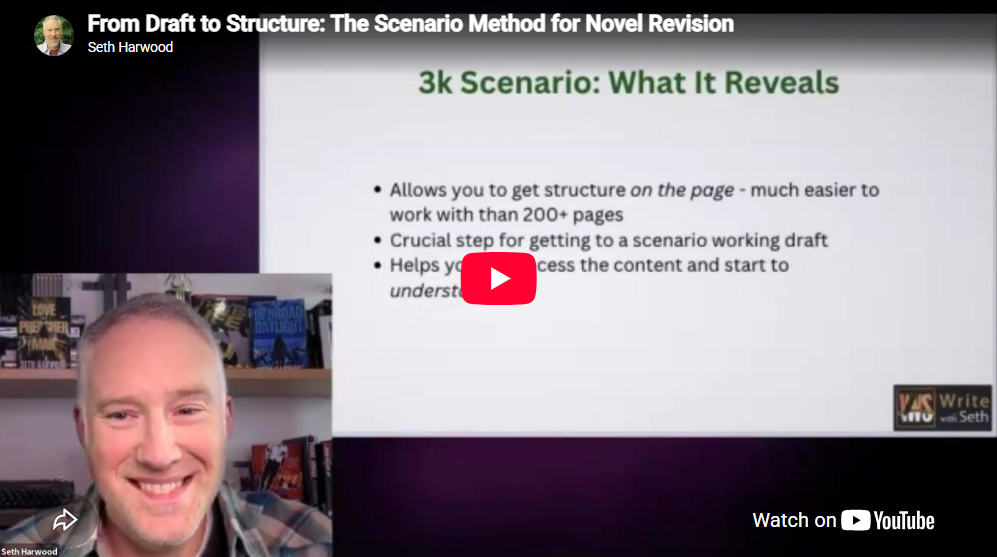
And if you’re not sure how to create a post-draft outline that actually gives you useful information — how long it should be, what level of detail to include, how to use it to drive your revision — that’s exactly what my Revision: From Draft to Structure course covers, step by step.
You can find the course here: writewithseth.com/revision-course/